HubSpot AI has arrived in many companies. The first use cases are quickly found. Formulating texts, preparing emails, summarizing meetings, speeding up content.
That's a good start. But not more than that.
Because the real question is not whether AI is activated in the portal.
The real question is whether it is already creating real business leverage in the company. There is a simple way to tell the difference. In helper mode, AI makes existing tasks faster. Emails get drafted more quickly.
Meeting notes appear automatically. Content takes less time. That is useful. But it does not change outcomes.
In growth driver mode, AI changes what is possible. Sales follow-up becomes more consistent because the CRM data behind it is clean. Lead prioritization becomes smarter because AI works within a defined process. Content becomes more relevant because AI is guided by positioning, not just a prompt. The output is not just faster. It is better connected to business results.
That shift does not happen by activating features. It happens by making three decisions first: what role should AI play strategically, what data foundation does it need, and which processes should it actually run inside. This is precisely where we are seeing a clear pattern in B2B companies.
Many teams are testing AI at an operational level. Few have decided what role AI should play strategically in marketing, sales and CRM. Even fewer have set up data, processes and responsibilities in such a way that initial functions become a scalable advantage.
HubSpot AI does not take effect automatically. It needs clarity. About goals. About data. Aboutprocesses. About handovers between marketing and sales. About the question of where AI should really relieve, prioritize or accelerate.
Here is what that looks like in practice:
A typical B2B company activates HubSpot AI and starts with email drafts and meeting summaries. The sales team is happy. Time is saved. But three months in, lead conversion has not moved. CRM data is still inconsistent. Sales and marketing are still working from different assumptions. The AI is faster. The process behind it is the same as before.
That is helper mode. It is not a failure. It is just not yet a growth lever.
If you set this up properly, HubSpot AI can achieve far more than just faster content. The result is better sales follow-up, more consistent communication, more intelligent prioritization, relieved teams and cleaner processes. This is exactly where a useful helper becomes a real growth driver.
Many companies underestimate one crucial point: from a certain level, HubSpot AI is no longer just a marketing topic. It becomes a RevOps topic.
The reason is straightforward. The biggest leverage does not sit inside a single feature. It sits in the connection between things: between data quality and segmentation, between CRM structure and sales follow-up, between content logic and conversion. These connections span marketing, sales, and service. That is the scope of Revenue Operations – and that is exactly where AI either compounds its impact or gets stuck.
If the handover between marketing and sales is unclear, AI will generate better-written emails into a broken process. If CRM data is incomplete, AI-powered prioritization will rank the wrong leads faster. The feature is not the problem. The missing structure around it is.This is precisely why clarity in goals, data, and process design is not a prerequisite for getting started. But it is the prerequisite for AI becoming a real growth driver.
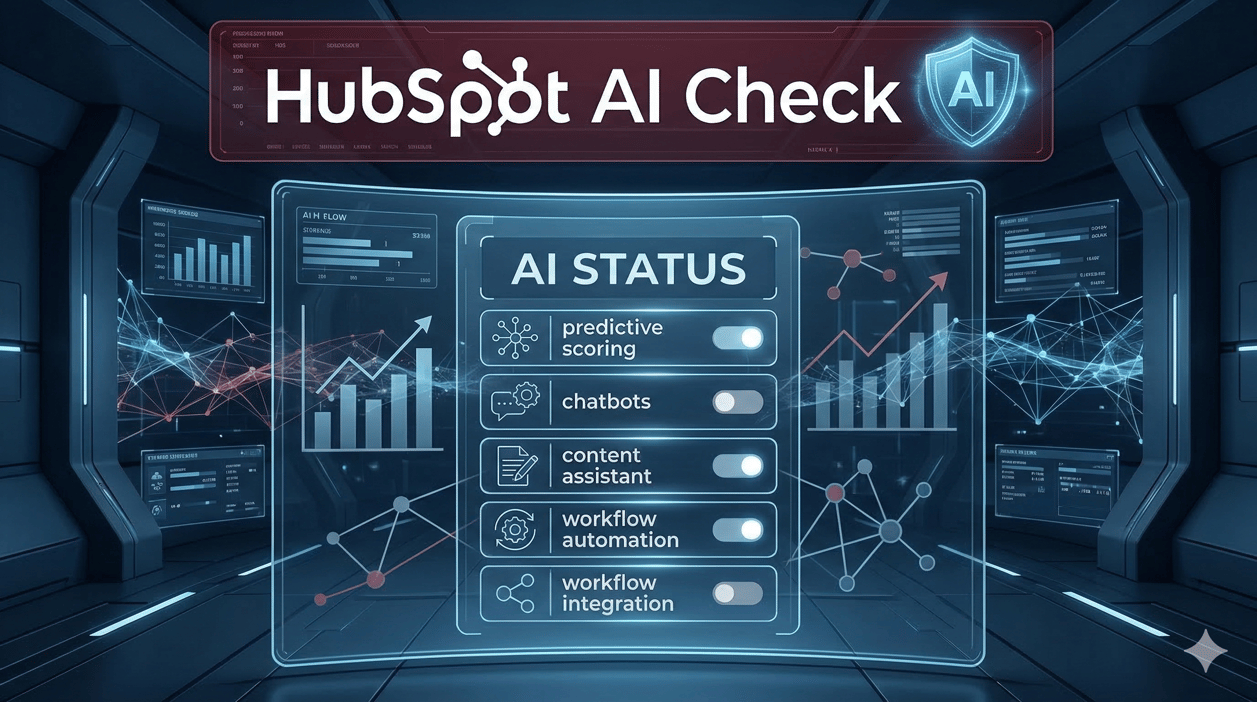
That is why we have developed a HubSpot AI checklist for decision-makers. The checklist covers five areas: strategic classification and governance, productivity and content control, sales and service processes, data quality, and process integration with impact measurement. Each area contains two questions – except data quality, which is covered by one. Ten questions in total. Each one answered honestly takes three seconds. The overall picture they create takes most companies by surprise.
What can the HubSpot AI checklist do?
It helps you to honestly classify your current maturity level and ask the crucial questions. For example: Is AI already strategically categorized for you? Have governance and data protection been clarified? Is your data quality sufficient? Is AI already working within your processes? And are you measuring impact or just usage?
The checklist not only shows you what is already working well today. It also reveals where the levers are that are usually not solved internally in passing. The scoring is straightforward. Every question is answered with yes, partially, or no. The lower your total score, the more mature your current setup.
A score between 0 and 4 means HubSpot AI is already embedded in your strategy, data, and processes. Between 5 and 10, the foundation is there – but relevant potential is being left on the table, usually in data quality, sales-specific use cases, or process depth. A score of 11 to 20 is the most common result. It does not mean you are behind. It means the opportunity ahead of you is concrete and reachable.
Most companies score somewhere in the middle. That is exactly where the checklist becomes useful.
If you want to know whether you are already using HubSpot AI with real impact or whether you are still leaving a lot of potential untapped, then this checklist is the right place to start.
Click here for the HubSpot AI checklist.

If you also want to know which two or three AI levers in your existing HubSpot setup generate the greatest business impact, we'll talk about this in the HubSpo Quick Scan. Book your meeting today and start seeing results within 30 days!

Frequently Asked Questions: HubSpot AI as a Growth Driver
Why Mark Lotse?

As a HubSpot Platinum Partner with over 20 years of B2B experience, we know: A CRM is only as good as the process behind it. We are "end-to-end thinkers". We accompany you from the initial analysis to the content strategy to technical perfection - so that your forecast finally delivers what it promises.
